- Stock Picker's Corner
- Posts
- It's the "Iran Energy Shock of 2026"— But Action Will Beat Fear
It's the "Iran Energy Shock of 2026"— But Action Will Beat Fear
Past shocks ('73, '79 and '90) tell us what to expect and how to invest — even as America's "affordability crisis" gets deeper ...

Stock Picker's Corner (SPC)
March 24, 2026
In This Issue
✅ How past energy shocks really played out — and what history tells us about the likely next moves in energy, inflation, markets, and investor behavior after a disruption like Ras Laffan.
✅ Why panic is optional — and costly — and how disciplined investors use volatility, fear, and drawdowns to Accumulate positions instead of making Wealth-Killing mistakes.
✅ Where the real opportunities emerge — the long-lived energy, commodity, and real‑income storylines that tend to outlast crises and reward investors who stay patient, contrarian, and prepared.
“What has been will be again … what has been done will be done again; there is nothing new under the sun.”
— Ecclesiastes 1:9
When I saw that Iranian missiles hammered Qatar’s Ras Laffan liquified natural gas (LNG) complex last week, this bit of biblical wisdom was the first thing I thought of.
I just couldn’t help it.
I’ve seen energy shocks before … and I’ve lived through them and worked through them ... and so have some of you.
Call this one the Iran Energy Shock of 2026. It looks and feels like the Arab Oil Embargo of 1973, the Iran Oil Shock of 1979 and the Iraqi Invasion of Kuwait in 1990.
And I pretty much told you it was coming.
And because people are predictable — meaning consumers, investors and political leaders react the same way and do the same things over and over — we can look at those past shocks to gauge the all-important “what comes next” responses in energy, the economy, stocks and more.
And that predictability helps us — because there truly is “nothing new under the sun.”
As Wealth Builders, we know that — and we turn that into a kind of “investing superpower.”
Since we kind of know what’s coming (human nature being what it is), it’s easier for us to control our emotions and our actions. That helps us “flip the script” and chart a Contrarian course. We keep our cool now — knowing that any turbulence “today” will be accompanied by some interesting opportunities “tomorrow.” With a bit of patience — and a long-term view — we’ll Accumulate our way to a big payoff.
Everyone else — that’s “The Crowd.” Their actions are the hallmarks of human nature. They react to scare headlines, succumb to emotion and abandon their game plans in favor of panicky, knee-jerk moves. For those folks, human nature is their nature — and it leads to costly mistakes.
They’re the Wealth Killers.
Let’s agree to avoid all that.
And the best strategy to do that is to look at what just happened with Ras Laffan, to understand how it relates to past energy shocks and to use all that insight to see:
What could happen next.
How to avoid those mistakes.
How to spot the opportunities that do always emerge.
And how to position yourself to win.
As I’ve been detailing here, the war with Iran is the latest contributor to an evolving era of perpetual uncertainty. There’s a list of things to watch – and act on. And it’s the kind of “wild card risk” I warned you about.
After years as the leader, Qatar has fallen to No. 3 on the list of LNG exporters — behind the United States (No. 1) and Australia (No. 2), says Statista.com (see chart below).
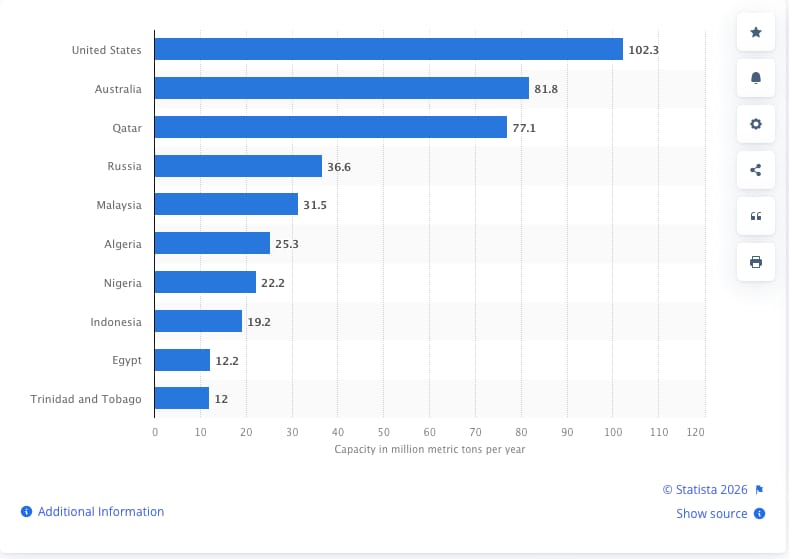
However, Ras Laffan is the world’s largest LNG-exporting hub — accounting for 20% of global LNG exports. Initial estimates say the missile-strike damage was enough to sideline 17% of Qatar’s LNG capacity for three to five years — at a cost of $20 billion a year.
European gas prices pogoed 35% in a single day, while Brent crude surged above $110 a barrel. Factor in the other energy supplies delayed or lost by strikes or the Hormuz Strait shutdown and we’re right now looking at the biggest single global gas disruption since the 2022 invasion of Ukraine by Russia.
But my mind immediately jumped to three other energy “disruptions” that I’ve seen, lived through and even worked through – and whose gouging effects I experienced, have written about and have studied extensively as a business reporter, analyst and stock picker.
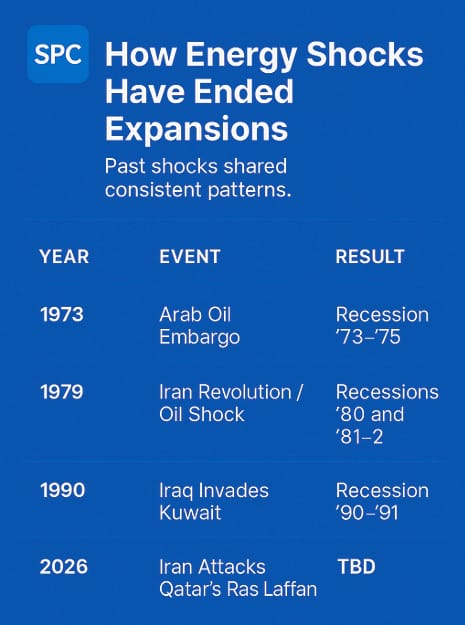
I’m talking about the Arab Oil Embargo of 1973.
The “First Oil Shock”
I was 11 when that embargo hit in late 1973. My Dad had been transferred from Pittsburgh to Baltimore — and I remember how difficult the move was. I remember how much gasoline spiked. I remember the gas lines my folks waited in.
And I remember how inflation zoomed even as regular families struggled — something economists now call “stagflation.”
Political scientists dubbed it “weaponized oil” and (later) the “First Oil Shock” — because others followed like World War II followed World War I.
The longtime journalist in me sees that oil soared from $3 a barrel in 1973 to $12-$14 a barrel by the time the embargo ended in early 1974 (or $22 to as much as $103, inflation-adjusted). The Standard & Poor’s 500 crashed more than 40%. The resulting recession lasted from November 1973 to March 1975.
But the aftereffects — or maybe “aftershocks” are a better term — cannonaded much longer. Stocks took 7½ years to rebound. And stagflation — something theorists had thought impossible — was like a temperature-inversion smog that choked America for the rest of the decade.
But if you bought at the 1974 bottom – when things looked and felt most dour — and had a long-term game plan, you did well going forward. You were buying when dividend yields were at 4% to 5%. Once those companies got around to “rebooting” their dividend increases, your “yield-on-cost” windfalls added to your share-price gains.
And if you “Accumulated” along the way — those rebound gains were magnified.
The “Second Oil Shock”
Then came the Iran Revolution Oil Shock of 1979. The revolution started the year before – and led to the overthrow of the Shah. And it triggered the “Second Oil Shock.”
Iran cut production by 4.8 million barrels a day — equal to about 7% of global output. That wasn’t much on its face; but panic buying doubled the perceived shortage.
Oil prices started their surge in mid-1979 — just before I graduated from high school.
I was driving now. And while my Dad could’ve said “Hey Will, I need the car for work … you can’t drive,” he was a good guy. I could drive his Toyota Celica fastback — but I had to sit in the gas lines, too. And I did.
We spent a lot of that summer hanging out in the local shopping plaza — or “idling” from one hangout to another.
Oil nearly tripled – from $13 to $34 a barrel — and briefly hit $50. Gas doubled — leading to those long lines, rationing and even the “odd/even” days at the pump.
Stocks fell sharply, with a 1978 drawdown of 26% and a 73% real decline from 1966–82.
And the affair triggered a global recession — and the “double-dip” downturns of 1980 and 1981-82.
Inflation surged — the U.S. Federal Reserve said it rocketed to nearly 7% by March 1979 — meaning stagflation returned.
In the spring of 1980, while home from Penn State — and waiting for my summer job to start — I worked the “graveyard shift” at the local Amerada Hess gas station. I first trained on the day shift – while odd/even rationing was still in force. I remember the lines — and odd/even rationing was still in force. I remember the anger and the attempted cut-ins (a duo from downtown Baltimore in a beat-up Impala threatened me with a knife). I also remember staying to help one morning — after a grueling overnight shift — when an ex-Hess exec got torqued when I didn’t accord him “special treatment.” He called the corporate headquarters in Woodbridge, N.J. and complained — but was rebuffed in full. (The regional sales manager — a really good guy, too — had taken a liking to me, as had the station manager.)
I was glad to leave that job — though my first day back at my summer swim-club job was the day the White House announced the failed U.S. hostage rescue mission.
But if you’d bought stocks there in ’79 — amid all that stress — you set yourself up to ride the rocket in the “Go-Go ‘80s.”
The S&P 500 gained about 206% from January 1980 to December 1990. That’s about 3x your money on a price basis. But you’re talking about a 4x to 5x gain including dividends.
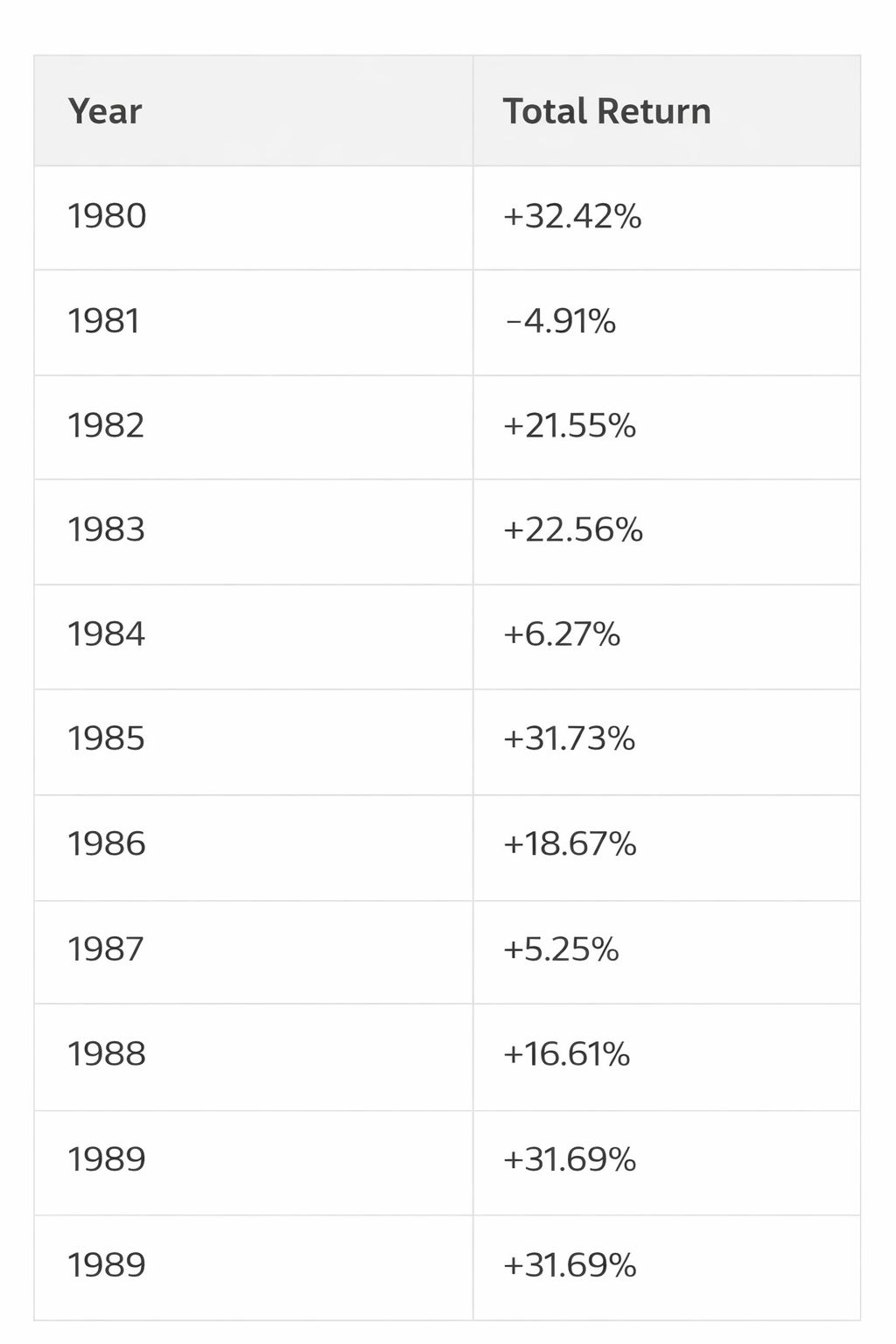
If you’d Accumulated along the way, the gains would’ve been even greater.
Which brings us to 1990 — and the invasion that launched the Gulf War.
Saddam’s Folly
On Aug. 2, 1990, Iraqi tanks and armored divisions rolled across the Kuwaiti border. Kuwait — producer of more than 2 million barrels a day and holder of 10% of the world’s proven reserves — was overrun in less than 48 hours.
The global supply scare was exacerbated by worries that Iraqi leader Saddam Hussein would also move on Saudi Arabia — producer of as much as 9 million barrels a day — sparking fears that 20% of the world’s oil supply was at risk.
Oil prices spiked from $17 a barrel to as much as $41 ($42.50 to $102.51 in today’s money).
Stocks dropped immediately: By October, the S&P 500 was down 20% — an official “bear market” (and the first one since 1987).
By that time I was into my third year as an award-winning business reporter for a Pennsylvania daily — and was ready to move up to a bigger market. America was already navigating the bank-lending slowdown of the savings-and-loan crisis (which I’d been covering at my previous job in Maryland). Unemployment spiked to 7% and the U.S. economy was shocked into a real (but short) recession – one that lasted from July 1990 to March 1991.
I knew I needed to find that “next job” — and quick — or I’d be stuck there for several more years. I did — right at the end of the year. Many of my friends and colleagues spent years at that paper, just as I’d predicted.
I also invested aggressively myself — though I made one mistake: I wanted to own Berkshire Hathaway $BRK.A ( ▲ 0.16% ), and as a poor reporter, didn’t have the $5,500 to grab one share.
I didn’t make that mistake a second time.
When the $BRK.B ( ▲ 0.18% ) shares started trading, I grabbed some — and have Accumulated since.
From that October 1990 market bottom to the end of the decade, the S&P 500 more than quadrupled — delivering double-digit gains in eight of the 10 years and pulling off one of the strongest valuation expansions in history.
Years of note included gains of 30.5% in 1991, 37.6% in 1995 and 33.4% in 1997.
Buying during that Persian Gulf Crisis era ended up as one of the best buying points in modern history — similar to buying:
In the ’74 doldrums.
During the ’82 recession.
In the March 2009 free-fall.
And during what I dubbed as the March 2020 “Infection Correction.”
I know what you’re thinking: “Okay, Bill, but how do we identify that market bottom?”
With the Accumulate Strategy, you don’t need to.
You’re buying at key points during the selloffs … and you’re buying at regular intervals (dollar-cost averaging) or as you get more cash.
That’s the Wealth Builder advantage.
So what happens next?
Why “Bad” Won’t Hurt You
As Matt Warder — a good friend and former Wall Street coal analyst — told me late last week: We don’t know yet.
No one does. Not for certain.
But we can watch for certain things.
“It really hasn’t sunk in yet,” said Matt, who also runs The Coal Trader research service. “This one will take months to play out. And I don’t think people have really thought it through yet. It’s very likely that the worst is yet to come.”
What does that “worst” look like?
“I think we are headed for an inflationary spiral that will result in a destruction of demand … and that is what will ‘right-size’ the market,” he told me. “I’m not sure if we [actually] get to a recession … at least not in the ‘econometric’ way we look at it. Instead of the two consecutive quarters of negative growth, we might have just one – with a bounce-back … think of it like taking the stairs up and the elevator down. Commodity producers will make a mint. It’s good for oil companies. But then people will realize that costs are going up throughout the economic system. When commodities go up, that increases costs along the supply chain. When oil prices go up, fertilizer prices go up. When fertilizer prices go up, food prices go up. When food prices go up, farmers [seem to] make more money. Unfortunately, inflation gives the illusion of growth — but at the expense of affordability: As those cost increases work their way through the supply chain and the economy, normal people can’t afford to buy as much, so demand (and price) declines.”
But the end game may well be the one we’re all struggling with now: Affordability may be a very long-term — if not permanent – challenge. The new price “floor” — for food, for gas and for other important goods — will be higher than it used to be, meaning we never get back down to where prices were in those “good old days.”
“That’s just it, Bill,” Matt agreed. “I fear that on the other side of that price cycle, we just see a much higher low. Imagine oil going to $200 — then back down to $100 (where it is now). That looks like a bargain in comparison — even though it started at $50. So what I’m saying is that this war could very well ‘bake in’ current gasoline, nat-gas, fertilizer and food prices — forever. Or at least until the world can afford to build out capacity again. And, going back to the ‘affordability’ issue, remember: All of this is happening at the same time AI is taking your jobs.”
That all sounds bad. And it would be — if it plays out that way.
But only for Wealth Killers.
They ignore the facts, wait for “clarity,” procrastinate — or even panic.
In short, Wealth Killers hesitate today — and suffer tomorrow.
Wealth Builders (like us) know how the game ends … know where this is all headed. We have a blueprint. We’re self-reliant.
We act today — and win tomorrow.
We find those “best storylines” — because those Wealth Building “investment narratives” have long lifespans. They’ll still exist — even on the other side of crises or “shocks” like this one. Storylines like Deglobalization, AI, Pro Sports as an Asset Class, the Hunt for the Next Biotech Blockbuster, the New Cold War and (as Matt reiterates) the Long-Term Commodities Supply Shortfall … have years of “staying power.”
So, too, clearly does the energy storyline. And the need for Real Income — like this stock with a 10% yield (which pays its dividend monthly).
So we can invest in the companies positioned to benefit — when times are good. And we can Accumulate more shares when times are bad — which will magnify our gains when times are good again.
Long term, “affordability” won’t be a challenge for you folks.
Wealth Killers don’t do any of this. They search for that “perfect moment.” They’re stuck. They’ll pay the price.
You won’t. You’ll win. And we’ll help you.

P.S. If you feel like you’re “light” on energy and commodities, take a look at the stocks that I detailed in a recent report.