- Stock Picker's Corner
- Posts
- Here Are Six Big Risks That Could Just Keep Growing
Here Are Six Big Risks That Could Just Keep Growing
And I'll circle back with a "game plan" that'll keep you above the fray ...

Stock Picker's Corner (SPC)
February 19, 2026
In partnership with

In This Issue
☑️Everyday encounters — from Walmart to restaurants — reveal what America’s middle class is up against right now.
☑️These “small moments” point to bigger economic threats that will shape the next phase of the market cycle.
☑️This issue breaks down the six big risks for 2026 — and what Wealth Builders should be preparing for next.
Every year, Harry, my best friend of 50 years, holds a Daytona 500 party at his house. My son, Joey — now 18 and a freshman at the Berklee College of Music in Boston — has been going with me for the last 10 years or so — and looks forward to it as much as I do. Last week, Joey hopped the “megabus” in Boston and endured the nine-hour trip to Baltimore — just so he wouldn’t miss it.
Saturday night found me at the local Walmart, where I loaded the cart with Dr. Pepper, Red Bull, Dietz & Watson deli meats and other snacks — just so we didn’t show up empty-handed.
I pushed my loaded (and squeaky) shopping cart into the checkout line — right behind a tall, powerfully built guy in work boots and a bulky set of bright-blue, thermal winter work coveralls.
Yes, he was big — but also friendly. He smiled and told me to jump ahead of him — which surprised me since he had a single case of bottled water in his cart, and a single chocolate bar in one giant paw … and my cart was, well, stuffed.
He quickly explained he was waiting for his wife and daughter — the three of them were out shopping for stuff for her dorm room. And once he started talking, there was no stopping him.
His first topic: That candy bar — a brand that I recognized (and that I’ve eaten “a few” of myself).
“Look at this,” he said. “They used to be this big,” he added, spreading his hands apart to visually make his point.
After telling him the term for that was “Shrinkflation” — and sharing what I did for a living here at Stock Picker’s Corner (SPC) — we were instant friends.
Our main topic: The “Middle Class Squeeze,” which you’re probably feeling yourself. It’s been a “kill shot” to the American Dream. But that squeeze could be lethal in a modern America that’s turned into a “rich person’s economy.”
What Will Your Retirement Look Like?

Planning for retirement raises many questions. Have you considered how much it will cost, and how you’ll generate the income you’ll need to pay for it? For many, these questions can feel overwhelming, but answering them is a crucial step forward for a comfortable future.
Start by understanding your goals, estimating your expenses and identifying potential income streams. The Definitive Guide to Retirement Income can help you navigate these essential questions. If you have $1,000,000 or more saved for retirement, download your free guide today to learn how to build a clear and effective retirement income plan. Discover ways to align your portfolio with your long-term goals, so you can reach the future you deserve.
And the threats are being lobbed in from so many directions that it’s tough to find cover.
In fact, the same day as my Walmart sojourn — but a bit earlier — I’d taken Joey over to see my Mom (he insisted). A retired nurse, my Mom just turned 88, but remains as sharp as can be. My wife is a CPA, and tax season is spooling up, so we let her stay home for some needed rest.
Within minutes of arriving, my Mom and Joey decided they wanted takeout from a nifty little Italian joint that’s not too far away. We called in the order and I went to get it so Mom and Joey could visit.
The restaurant was packed (it was Valentine’s Day), so I had to wait a bit. With our food order finally in hand, I tapped the “reader” with my credit card. I was pretty peeved when the “suggested” tip prompts came up as 18%, 23% and 28%.
That’s right, folks: Welcome to “Tipflation,” which has seen those card-reading “point-of-sale” terminals programmed to “suggest” gratuities as high as 30% — an anathema to longtime consumers like me who remember when it took “exceptional” service to rate a tip of 15% (and then only when dining in).
At 30%, you’re talking about an end-of-meal addition that boosts the cost of dining out by nearly a third. And a 30% tip on a takeout order? Yikes.
Standing there in the Walmart checkout line, I watched my new “friend” grimace as I shared that anecdote as a quid pro quo for his candy bar comments.
I understood the tension behind that grimace. On their face, they seem like egregious bookends — twin assaults on the wallets of America.
Here on one end, you get less for the same price (Shrinkflation); at the other end you pay more for the same level of service (Tipflation).
Truth be told, they’re merely the visible threats.
And there are plenty of others. And my hardworking, gentle giant buddy in the checkout line — frustrated for himself and his family — inspired me to take a closer look.
But looking and warning aren’t enough. And here at SPC, we always go that extra mile — for you.
So here today, I’ll outline some of the threats you need to watch for. As the old maxim tells us, “forewarned is forearmed.”
Being prepared is great. Knowing what to do is better.
Self-reliance and independent thinking drive long-term success. And they’re the hallmarks of a Wealth Builder.
In an economy where “volatility and risk” are emerging as the new watchwords, you also need an actionable blueprint. Investors who recklessly throw caution to the wind — and turn to day trading to make up the gap — will (eventually) get creamed. It’s only a matter of “when.”
We’ll help with that, too: I’ll circle back next time with actionable tips — including foundational stock picks — that’ll give you the confidence to think and act for yourself.
So let’s get started …
Mounting Risks?
Let’s talk first about the economic risks that America faces. After all, how can you be “forewarned” if you don’t know what to watch for?
Here are six risks to consider.
Risk No. 1: The Aging Economy
Our last recession was the “Infection Correction,” my term for the COVID-19 downturn of early 2020 — extremely sharp but historically short at just two months. Since 1900, America has averaged one recession every 5.4 years — though they’ve become less frequent since 1950.
“Expansions” usually last from six years to a decade. We’re in Year Six now — long, but not unprecedented (the longest was the 11-year run from 2009 to 2020).
Am I predicting a recession?
No, not at all.
But what I am saying is that the longer we go, the more risks we incur and the closer we get to the end of this expansion, that “next recession” — and the market stumbles that come along, too.
This has been very much a “policy-driven” expansion. We’ll need additional U.S. Federal Reserve interest-rate cuts to prolong it — and to keep stocks rising. We’ll need tax cuts, too. And targeted government spending — public/private investments to jump-start America’s critical-minerals push and other outlays to “reshore” U.S. manufacturing and to rebuild domestic semiconductor production.
Which leads to the next risk …
Risk No. 2: Those Pesky National Stressors
When I said this will be a “policy-driven” economy, I’m talking about fiscal and monetary policies. Fiscal policy includes tax revenue and those targeted outlays I mentioned. Monetary policy is central bank rate moves or “open-market operations” that boost or cut the money supply.
But with the Congressional Budget Office (CBO) projecting a $1.9 trillion budget deficit for Fiscal 2026 and with a national debt load approaching $39 trillion, Washington’s maneuvering just keeps getting tighter. During a downturn — or a financial crisis — this means the pump-priming tools may not be fully available. And they also bring spinoff risks, as we’ll see next.
Risk No. 3: A Rising Risk of “Stagflation”
Having lived through the 1970s, I can tell you firsthand that stagflation is the worst. With inflation, you’re usually talking about price increases being driven by an overheated economy. It’s lousy, but if your paycheck keeps pace — possible since times are good – you might navigate it okay. With deflation, you’re talking about falling prices – which sounds good except it usually happens when the economy is falling, too. Consumer demand slides, which cools the economy even more — and it spins into a kind of self-perpetuating slowdown.
But stagflation is the “nightmare scenario” — rising prices in the face of a lousy economy.
Companies are slashing workers, unemployment soars, corporate profits plummet and stocks skid — but prices for must-have items surge higher. In other words, everything gets more expensive — even though you’ve got less money to pay for it. Right now, the U.S. economy has the ingredients in place for inflation and potential stagflation. Remember my earlier note about U.S. debt? Well, every 1% change in market interest rates can boost (or cut) U.S. interest payments by $250 billion to $300 billion a year.
The Trump Administration clearly wants rates to fall so it can pay less in interest and spend more on areas like U.S. defense. But rate cuts at the wrong time can be inflationary. And inflation meshed with a big economic slowdown (or outright recession) could be stagflationary.
There are plenty of variables — enough to qualify as economic “wildcards.” Said the folks at Stanford’s Institute of Economic Policy Research: “Interest rate decisions, the national debt, tariffs, worries about a stock market bubble and the low-hire, low-fire labor market are among the big economic issues that [are taking] center stage in 2026.”
Risk No. 4: The Wealth Effect in Reverse
We’re getting a real-time look at worries about an AI Bubble – something worth watching if the resultant selling spreads to the broad stock market. When stocks rise (and especially when they rise a lot, as they have the last few years), consumers feel safer and happily spend more – a concept known as the “Wealth Effect.”
But the opposite is true – especially when a bearish turn in stocks exacerbates already existing worries.
Consumers pull back — a nettlesome problem in an economy like ours that gets 70% of its oomph from the dollars they spend. At a time when aggregate inflation – the price increases that have compounded over the past few years — makes the household dollar stretch less, a siphoning away of wealth could be just the trigger that brings on that “next recession.”
Some of those ingredients are already present.
Risk No. 5: That Middle Class Squeeze
The American job market is cooling. Hiring has slowed and unemployment, now at 4.3%, could run as high as 4.6% — not disastrous but definitely a stressor. Consumer debt hit a record $18.8 trillion in the fourth quarter — meaning that capacity to borrow more to keep spending just keeps getting tighter.
Spending by lower- and middle-income households is already slowing.
That’s already leading to multi-quarter earnings declines at consumer-facing units in big companies like Stanley Black & Decker $SWK ( ▲ 0.4% ) , Carrier Global Corp. $CARR ( ▲ 0.17% ) and 3M Co. $MMM ( ▲ 0.86% ) .
Risk No. 6: Those Worrisome Wildcards
I’m fond of old maxims (it’s surprising how grounded in truth they seem to be). So here’s another one that works right here: What you can’t see can hurt you. With investors and consumers like us, it’s the “stuff” that seems to come out of nowhere that can be a killer.
I can’t predict these with a high degree of accuracy. But I can make some educated guesses.
One that I’m watching right now — that has me worried and that I plan to tell you more about next week — is the potential for a “private credit meltdown.” We’re talking about a stealthy lending market — one that’s massive, not well understood and not well supervised or regulated.
The International Monetary Fund (IMF) conservatively estimates this as a $1.5 trillion to $2 trillion market. But it’s probably bigger. Some of the worries I have resemble the issues created by mortgage-related “credit-default swaps” and toxic mortgage-backed securities ahead of the Great Financial Crisis — though there seems to be more awareness of private credit. Other wildcards include growing global cyberthreats, Beijing’s increasing flintiness, general Deglobalization and a Washington (and country) that’s more polarized than I’ve seen in years.
There you have it: A primer on “The Rising Risks of 2026.” It’s not a complete list. And it’s just a starting point for us.
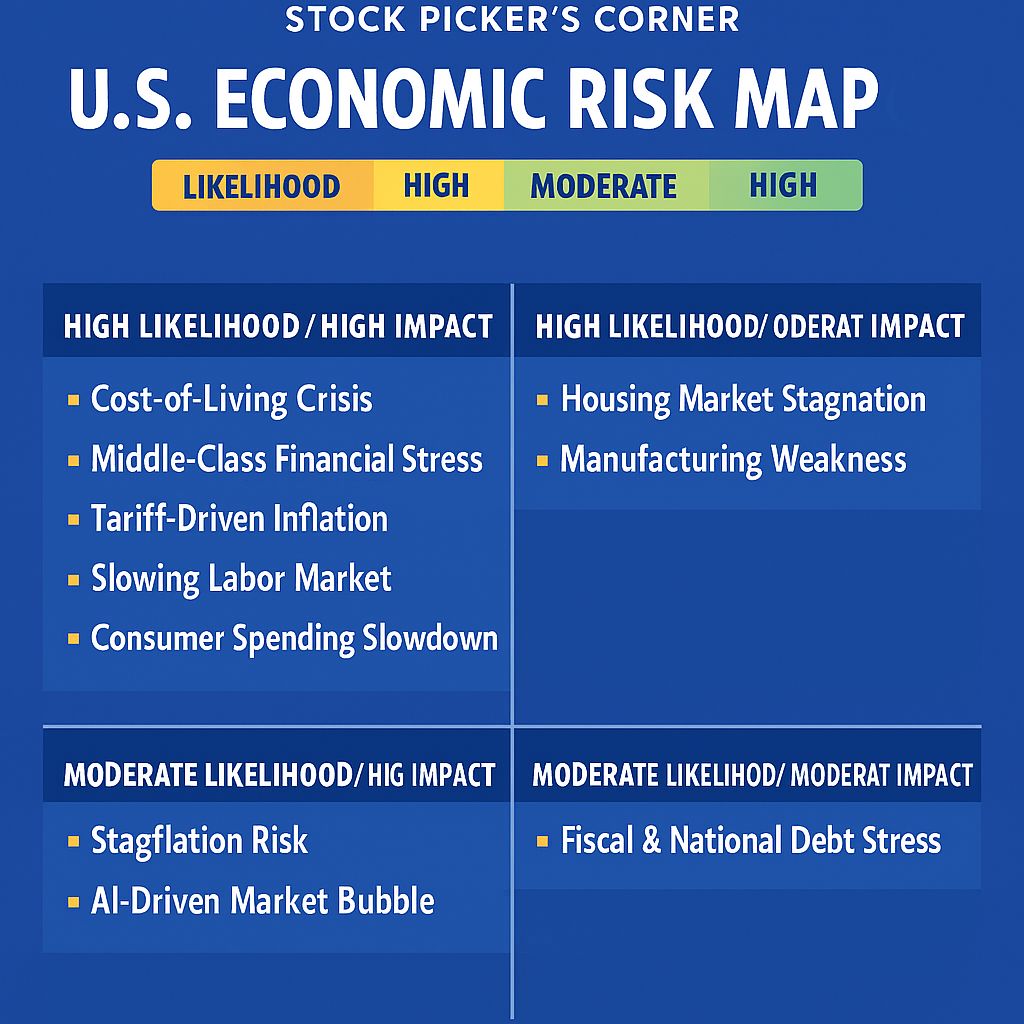
You see, one of the biggest shortfalls of investing “newsletters” and “services” is this: They spout off lots of analysis, theories and opinions — something an old boss of mine snarkily dismissed as “bloviating” … because they don’t tell you what to do.
Probably because they can’t.
They’re just not good enough, smart enough or don’t care enough about their subscribers.
My old boss was right, of course.
And from Day One here at SPC, we’ve made it Job One to avoid this trap.
We are good enough. We are smart enough.
We’re incentivized to be good and smart because, above all, we care about you.
That’s why we started SPC.
That’s not bloviating. It’s honest.
And it’s why I’ll be back next time — to handicap some scenarios … and some moves you can make.
Immediately.
And don’t get too spooked: With risks come opportunities. And remember, too, that over the long haul, markets go up. Both are good for us.
See you next time …

Explore More SPC Research | What SPC Premium Covers | SPC Premium Resources |