- Stock Picker's Corner
- Posts
- As Others Grow Fearful, We Set You up for the Rebound to Come
As Others Grow Fearful, We Set You up for the Rebound to Come
The "VIX Owner" keeps winning ... these spinoffs are hot ... and a $14 stock to bank on ...
Sponsored by

In This Issue
☑️ Fuller’s “don’t fight forces” philosophy becomes the Wealth Builder rule for navigating fear‑driven headlines, volatility spikes, and market noise.
☑️ Long‑term forces — economic growth, rising markets, and powerful storylines — reward investors who stay disciplined, invest (not trade), and use pullbacks to Accumulate.
☑️ Today’s market mess creates opportunity: from structural winners like CBOE to special‑situation breakups and Accumulate‑ready plays like Nu Holdings.
Every time I see big, scary headlines …
Every time “experts” sound the alarm for the American economy …
And every time U.S. stocks take a big hit (like they did yesterday, with the S&P 500, Dow Jones Industrial Average and the Nasdaq Composite Index each skidding 1.5% or more) … I think about R. Buckminster Fuller — and this elegant quote:
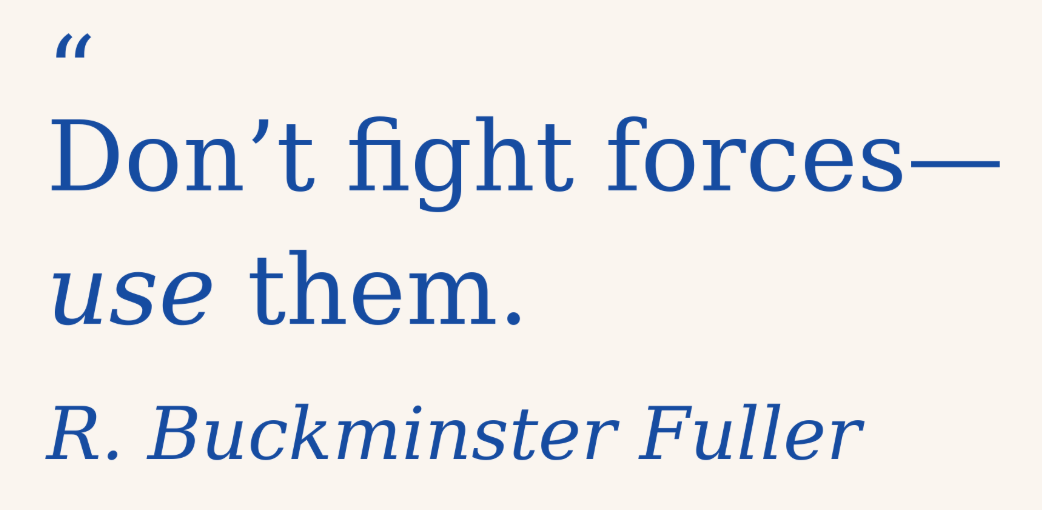
Elegant. Simple. Powerful.
A five-word passcode to a great life at home … to success at work … and, for our purposes here today, a lifetime of winning with your money.
No coincidence: Fuller’s bit of wisdom has the same word count as ours: “Wealth Builder or Wealth Killer.”
But we’re all human. Subject to human foibles. So we need reminders now and then – especially when events (war with Iran, toxic private credit and the ongoing Middle Class Squeeze) threaten common sense and the long-game view.
So let’s use today as that “reminder” — but with some bonuses.
Let’s talk about the all-important “what comes next.” Let’s talk strategy. Let’s talk about rules to live by. Let’s identify mistakes to avoid. And let’s end by talking about specific moves to make – including some stocks to look at.
But let’s start by circling back to my starting point … that quote … and a bit of background about R. Buckminster Fuller.
A “Force” For Good
My Dad — William Patalon Jr. —was an engineer … and a good one, with two physics degrees and a career that spanned more than 50 years. But he was also a musician, a woodworker, a car restorer, a home-repair guy, a movie buff and the consummate family man. Though I’m a career-long professional writer, I have a quantitative side — nurtured by my MBA in finance and years spent covering companies, stocks, financial markets and cutting-edge technologies.
So Dad and I always shared a common ground. And I’ve always admired the engineering mind — and guys like Fuller, who was born in Massachusetts in 1895, and who started designing and building cool new things in his pre-teen years.
Fuller worked as a machinist, served in World War I and studied at Harvard — where, as a “non-conformist” fraternity member, he was expelled two different times.
When an early attempt at innovative entrepreneurism — he and his father-in-law developed a housing system that was lightweight, waterproof and fireproof — failed in 1927, Fuller considered suicide. A spiritual epiphany stopped him — but also reshaped the way he saw … everything.
He came to understand that the world around us is built from “forces” that you can’t avoid, stop or overpower. But you can align yourself with those forces. And you can redirect them so they work for you.
Whether we’re talking about nature, the universe, a company’s operating “culture,” a political system, the economy, or even the stock market, we’re talking about a “system” — a collection of interacting “forces” whose cause-and-effect ripples drive the outcomes that drive our lives.
Powerful stuff — especially when you put it to use … instead of just “going along for the ride.”
Fuller believed:
Nature is efficient because it never wastes force.
Too many human-made systems fail because they ignore those forces – or worse, arrogantly try to outmuscle them.
A good design works with those forces instead of fighting them.
And win when you build something that bends, flows, adapts or channel those forces – instead of resisting them.
In short, a good design doesn’t overpower the forces at hand — it aligns with them.
Fuller put those beliefs to work. He published more than 30 books and was awarded 28 U.S. patents — including one for the “geodesic dome,” a spherical structure whose force-distribution design gives it tremendous strength for its weight. He also inspired the name of the “fullerene” — carbon molecules whose spherical, geodesic‑like structure were discovered after his death.
In short, the whole “don’t fight forces” maxim is really a design principle, a leadership principle and a life principle — all in one.
It works for leadership, deal negotiations, conflict resolution, time management, health and fitness …
And, yes, wealth building.
Because the “stock market” is one big accrual of all the individual, institutional and algorithmic investors and traders, it’s also a living organism — one driven by such interconnecting forces of fear, greed, liquidity and momentum.
Wealth Builders like us understand this — and “use” those forces to our advantage. All that investor “liquidity” flows in our direction (and into our pocket).
Wealth Killers ignore this — be it through inexperience, a lack of insight or just (and I hate to say this) pure arrogance. They end up fighting those forces: Picture one of those hulking, armored Brink’s trucks (packed with everyone else’s money) careening at you head-on, and you’ll understand how I see it.
But if you’re new to Stock Picker’s Corner (SPC) — or you just need one of those “refresher/reminders” to keep you on task in the face of the recent messy stock market — how do you embrace “Fuller’s Physics” … and “use” those forces to help you?
Let me show you two lessons that’ll set you up for success.
Lesson No. 1: Make that "Force” Be With You
Let’s begin with a look through the “macro” lens — and start with the most-basic force rule of all: Over the long haul, stock prices tend to rise. A lot.
Go back 125 years and you’ll see what I’m saying.
In 1900, the U.S. economy was worth $590 billion. And the Dow Jones Industrial Average — not quite four years old at the time — opened that New Century at 66.08.
Since that time, we’ve been through World War I and World War II, the Korean and Vietnam wars, two Gulf Wars, the beginning and end of the first Cold War, and the start of the New Cold War, 9/11, countless presidential elections, the Panic of 1907, the Great Depression, the Great Financial Crisis and the Great Recession, the Crash of ’29, the Crash of ’87, the civil rights protests of the 1960s, Watergate, the Savings-and Loan-Crisis, the Dot-Com Bubble and the COVID-19 Pandemic.
And those are just the highlights (or lowlights).
Today, the U.S. economy has grown to $31 trillion — nearly 53 times bigger.
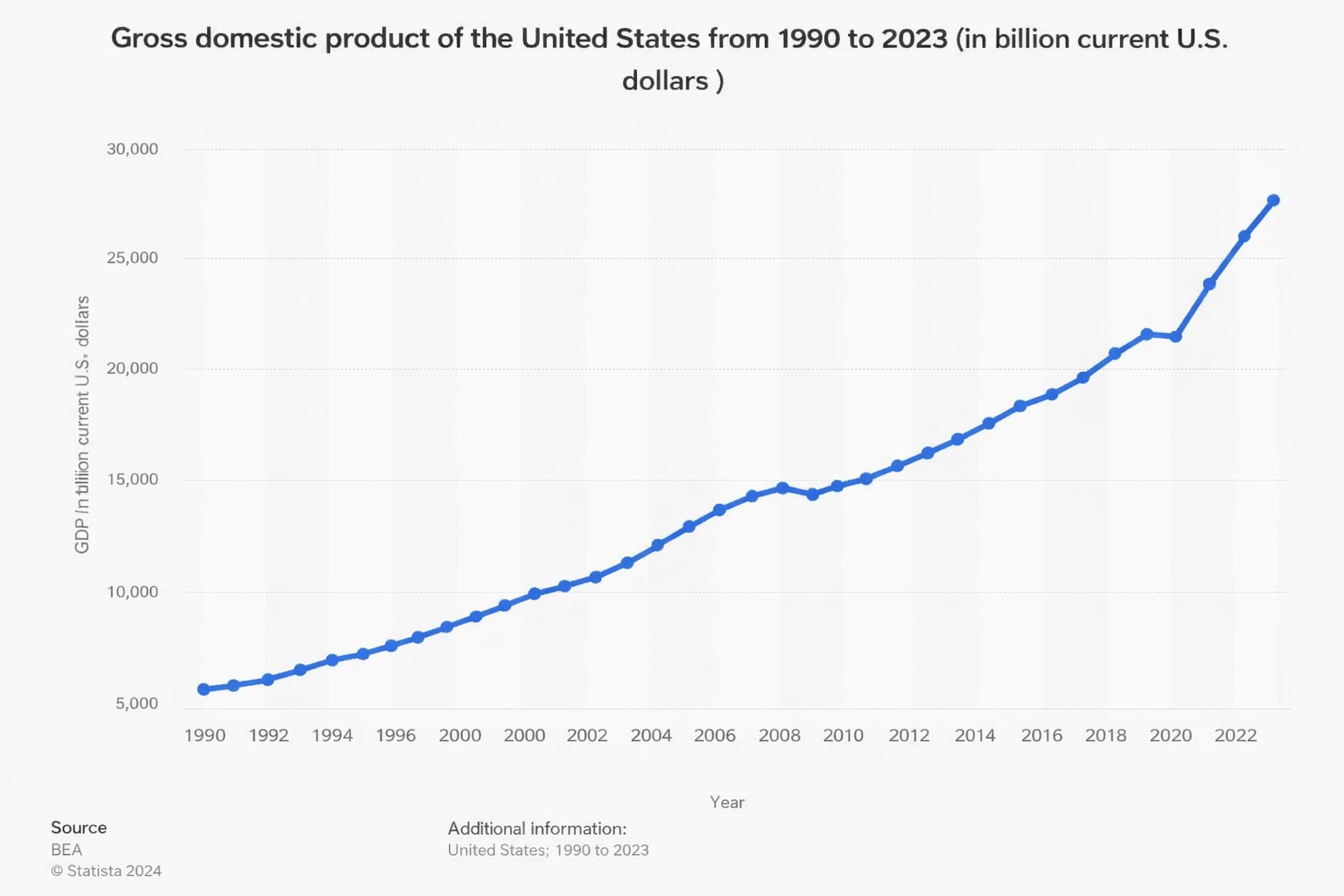
Source: BEA
And the Dow zoomed to a peak above 50,500 — 764 times higher.
For Wealth Builders like us, it’s the long run that matters. Indeed, if you look at the stretch between 1928 and 2022 — and slice that into 10-year increments — 94% have been positive.
Takeaway: Long-term, financial forces push stock prices higher. To use that force, you need to play the long game.
You need to invest, not trade.
And, remember, we’re just talking about the market averages.
If you want to do better, find stronger forces. Here at SPC, those “stronger forces” are the major storylines that we’ve diligently researched and carefully follow for you.
Those storylines are powerful “forces” in their own right. Storylines like Pro Sports as an Asset Class or the New Cold War or the Space Economy or even the tragic Death of the (Middle Class) American Dream.
Along with our “You’re Either a Wealth Builder or Wealth Killer” philosophy, we believe that “if you find the best storylines, you’ll find the best stocks.”
We refer to those stocks as “Money Doublers.” And they’re some of the best investments of all.
So if you find great storyline/great stock companies — and you play the long game — you’ve taken one of strongest Wealth Builder force of all …. and made it your ally.
But I can hear what you’re asking: “But what about what’s happening right now, Bill?”
Great question. Glad you asked.
Which brings us to the second “use forces” strategy.
“Force” Multiplier
I said it once. But I need to repeat it.
Wealth Builders invest.
Wealth Killers trade.
By focusing on the long haul, you aren’t victimized by your own emotions. You avoid the ultimately ruinous allure of short-term trading, or speculative vehicles like options — which retail investors should avoid at all costs.
In short, you aren’t “fighting forces.”
But the military has a term – “force multiplier”— that fits here. We’re talking about taking a seemingly small thing — and using it to produce a big impact.
During WWII’s “Battle of Britain,” the outnumbered Royal Air Force (RAF) turned its early advances in radar (and its communications network) into a major force multiplier. It gave very early warnings of Luftwaffe raids, let the fighters stay on the ground longer and let the RAF better direct and concentrate interception missions.
RAF Marshal Sholto Douglas said that “the Battle of Britain might never have been won … if it were not for the radar chain.”
(One of our Model Portfolio companies has developed just such a “force-multiplier” technology — but a modern one. And the company’s stock has been hot — super hot.)
At SPC, our “force multiplier” is the “Accumulate” strategy: We establish foundational stakes in the stocks we like. And we look to add to those holdings on pullbacks or as we have more cash to invest.
Again, U.S. stocks tend to rise over time. And longer stretches put the odds — and profits — on your side.
For Wealth Builders like us, it’s the long run that matters. Indeed, if you look at the stretch between 1928 and 2022 — and slice that into 10-year increments — 94% have been positive.
From a Fuller perspective, we’re again “using” forces — in this case, bearish forces. Bearish forces — when stocks fall — induce lots of folks to trade options or “go short” to profit. Trouble is, those aren’t simple strategies — especially for retail investors. Market downturns can be quite short-term (just look at the snapback rebound back in April). And you don’t know when the “force” will switch from bearish to bullish; if you’re short, you’ll suddenly be fighting the very forces you thought you were using.
As you see in the chart below I shared not long ago (not yet updated for current conditions), corrections tend to be much shorter in duration than bull markets.
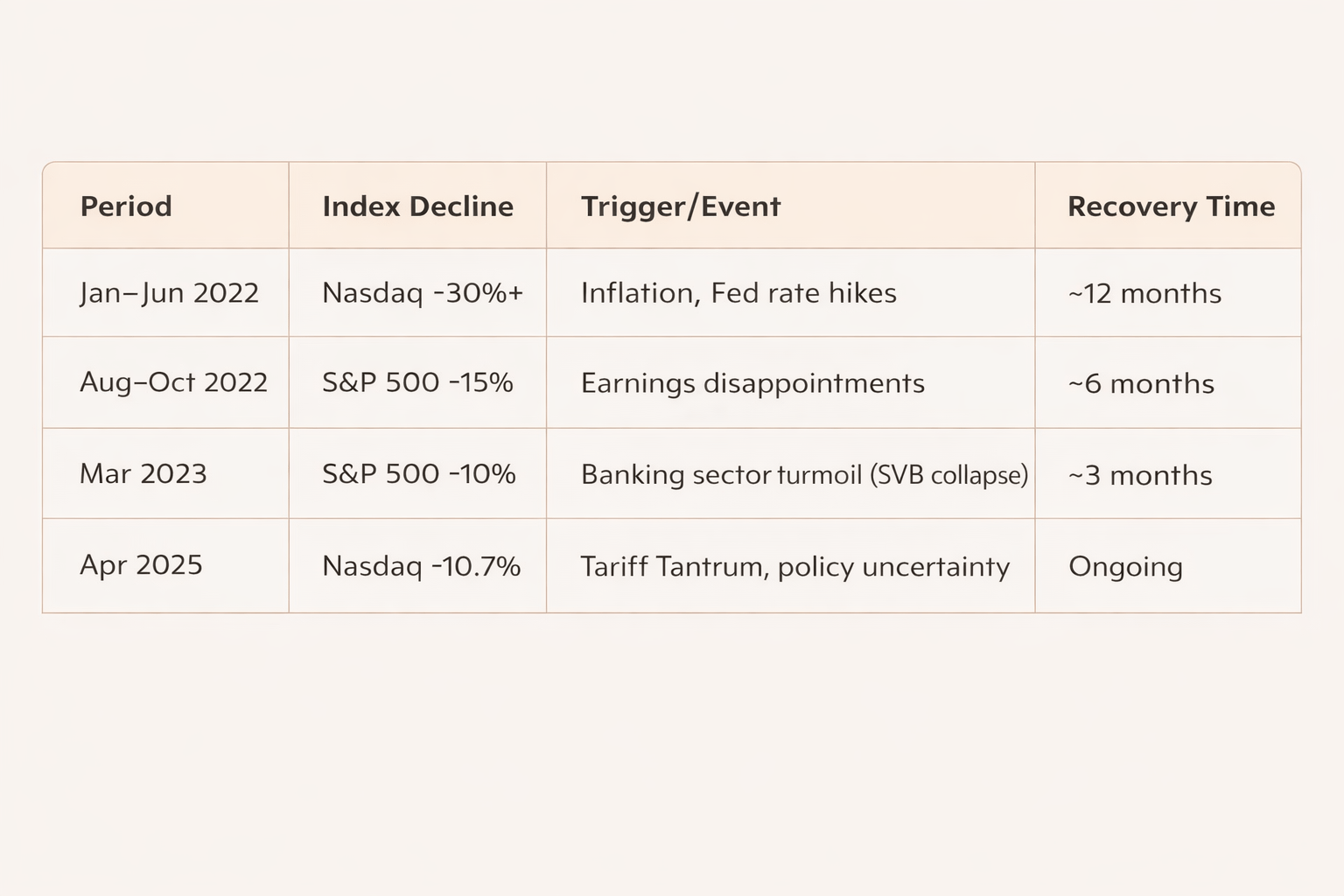
But you can “use” that near-term bearish force to add to your holdings. Then you’ll magnify your gains when the bullish force — the dominant and long-term force in stocks — ultimately reasserts itself.
Takeaway: The longer you go, the greater the odds you’ll navigate “events” like some of the ones I listed earlier. The better the chance that you can “smooth out” the near-term whipsawing that tends to accompany them. And the greater the chance you’ll have at smoothing out any of the mistakes that all of us occasionally make.
And you can use near-term setbacks to Accumulate — magnifying those gains — by creating lower average “buy” costs on the stocks you hold.
And with each new stock we add to the SPC Premium Model Portfolio, we forecast long-term stock-price growth and we detail Accumulate strategies for buying on pullbacks.
Those Stock Ideas
So what should you be looking to grab right now?
For starters, take a look at CBOE Global Markets Inc. $CBOE ( ▲ 1.74% ) , a leading options-trading exchange that’s been an exceptional player over the two years since SPC debuted in early 2024.
CBOE is using a “force” of its own — it’s a big beneficiary of the continued surge in options trading; in other words, you’ll profit from all those other investors who just keep “fighting forces” and never learn to use them.
CBOE shares are up about 16% so far this year, 39% over the last 12 months and nearly 180% over the last five years.
It operates the so-called “Fear Gauge” — the VIX — which spiked 12.6% yesterday.
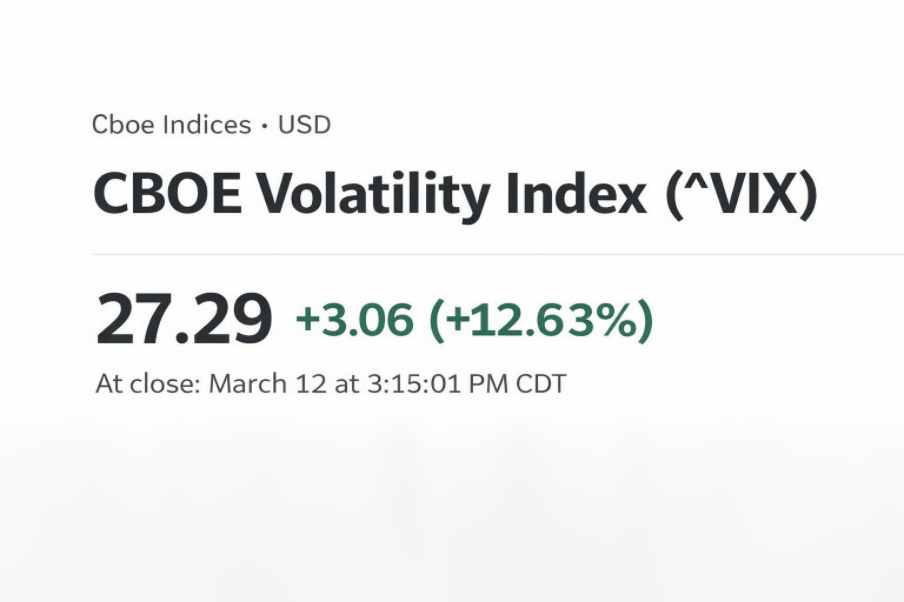
Source: Yahoo Finance
We like CBOE – and others do, too: It could end up as a suitor or takeover target should we see another round of buyouts in the trading exchanges — which I’ve seen several episodes of over the last 40 years.
And I’ll share a research update we did for SPC members last year.
One category of stocks to look at are “special situations.” More specifically, I’m talking about corporate breakups/spinoffs – and with good reason: We’re often talking about complicated companies — with promising businesses whose “force” potential is blunted by corporate bureaucracy. By granting these businesses their financial and strategic “independence,” these “SpinCo” ventures are often transformed into “forces to be reckoned with.”
There are two corporate breakups I’ve been following: These financial declarations of independence are unleashing forces in artificial intelligence, aerospace, power generation and (maybe coolest of all) quantum computing.
I just updated SPC Premium readers on these two, specific special-situation plays a week ago. SPC Premium members can check that report out here.
Indeed, in addition to our Model Portfolio, we have a dedicated Special-Situation Portfolio. Those tend to be terrific stocks to Accumulate during messy stretches like this.
Let me share one more stock. It’s a company I like. It gets you outside the U.S. market. And it’s way up from where I first told you folks about it just about a year ago.
That company is Nu Holdings Ltd $NU ( ▼ 0.96% ) — a São Paulo, Brazil-based digital financial-services firm that operates mostly in Latin America, including Brazil, Colombia and Mexico. The company, also known as Nubank, is making hay in “underbanked” Latin America. Nu’s shares are up 39.5% since I told you about the company here.
They were up as much as 90%. And that makes it a great Accumulate candidate worth studying. It’s been tripped up a bit by the growing private-credit mess, though the company’s credit quality seems to be improving as it looks to expand into America.
I plan to take a new look at Nu very soon; I’ll share that update here.
Final Action to Take: If stocks, the economy and the big mess we know as “global geopolitics” keep getting worse, keep your wits about you. Remember that “Bull markets make money; bear markets make fortunes.”
Use forces — don’t fight them — and you’ll create that fortune for yourself.
And we’ll help you.
