- Stock Picker's Corner
- Posts
- Elon's $2 Trillion SpaceX IPO Will Ignite These Five "Space Economy" Stocks
Elon's $2 Trillion SpaceX IPO Will Ignite These Five "Space Economy" Stocks
It's the biggest-ever IPO — and it says you can't afford to miss this

Stock Picker's Corner (SPC)
April 03, 2026
As part of our Investing 2026 Forecast Series back at the start of the year, we introduced a brand-new storyline: The Space Economy.
And we predicted 2026 would be the year this whole new market reached “critical mass.”
And two major stories in the last few days are proving us right:
No. 1: On Thursday, Elon Musk’s spaceflight venture SpaceX reportedly boosted the valuation of its looming IPO to $2 trillion (that’s right, we’re talking about “trillion” — with a “T” — a record for an initial public offering). So we’re looking at a newly public company that’s worth more than the economy of Australia.
No. 2: On Wednesday, the four-person Artemis II crew lifted off from NASA’s Kennedy Space Center in Florida — the start of a 10-day journey around the moon and the first crewed mission outside of low-Earth orbit (LEO) since 1972.
Other stories are simmering, too — developments I’m sure we’ll be talking more about here. But I have to ‘fess up: I’m stoked as can be about this — for a bunch of reasons.
First and foremost, I’m old enough to remember the first moonshot program — launched by then-U.S. President John F. Kennedy the year after I was born. The momentum surged throughout the 1960s, culminating on July 21, 1969, when Apollo 11 astronaut Neil Armstrong took that “one small step for man, one giant leap for mankind” — a goosebump-inducing moment my parents, two sisters and I watched on our black-and-white Zenith TV, while sitting on our family room couch in Murrysville, PA.
Like millions of kids — and tens of millions of Americans — I was obsessed with the Apollo space program. As the son of a (First) Cold War engineer who worked on airplane and submarine programs, I was already obsessed with aviation — and spaceflight was an easy addition to my list of passions. I built plastic model spacecraft, launched Estes rocket models, visited science and aviation museums, clipped stories from The Pittsburgh Press (which I have), and wrote to aerospace companies asking for photos, plans and other mementos (and I still have them, too).
Half a century later — with the benefit of my 42 years as a reporter, author, financial columnist and analyst — I can look back and see that this (First) “Space Race” was a seminal moment in the global chess match we understand as “nationalism.” As Americans, we naturally look back on this with pride: After all, we won — beating those nasty “Russians” to the moon.
But, thanks to that same “lens of experience,” I know that the 1960s Space Race triumph was more than a “moral victory.”
Much more.
It was an era of intense innovation, with focused goals — that boosted our standard of living, spawned all sorts of new products and services … and unlocked incalculable wealth.
If you’re a student of history — like I am — you know that one thing’s for certain: Americans love a challenge. We love those “rally-‘round-the-flag moments” that define us in history. We showed that in World War II — as the “Arsenal of Democracy” that saved the free world. And we showed it again in the ‘60s, when that “Let’s Beat the Russians” mindset put those guys on the moon.
That U.S./USSR rivalry fueled rapid advances in rocketry, super-fast computing and satellite systems. It redefined what was possible. It inspired generations of scientists, inventors … and dreamers.
Stuff we take for granted today took root back then:
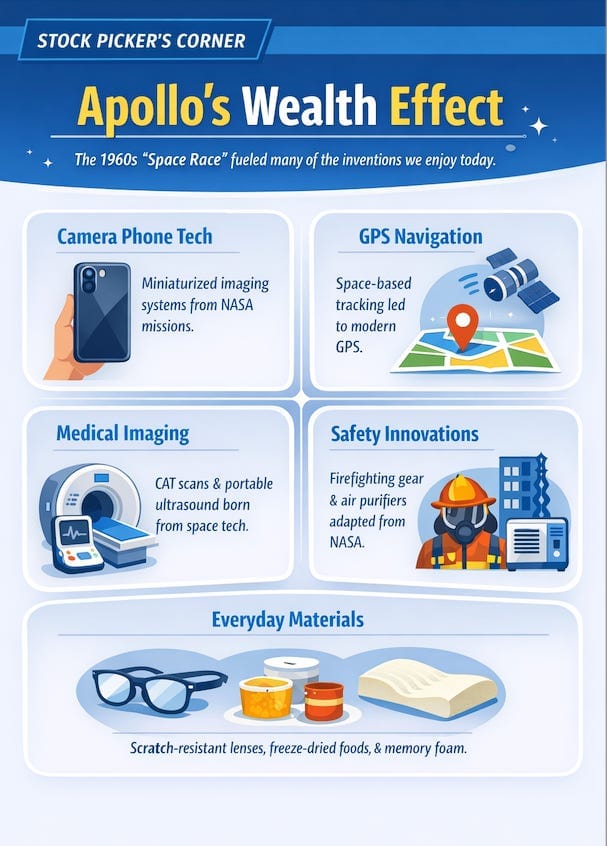
Researchers have described this as a “societal bubble” — a compressed period of intense investing, focused innovation and encouraged risk-taking … supercharged by this sense of “national mission.”
With the benefits of hindsight, the technology advances are clear — as are the observable economic benefits.
According to The Planetary Society, an estimated $28 billion was injected into the U.S. space program — from the early 1960s to about 1973. That’s about $338 billion in today’s dollars — and includes everything from Gemini to the lunar robotics efforts. If you add in all the indirect programs, current-day dollar outlays reached as high as $1.2 trillion, says Apollo11Space.com, a website dedicated to that space program’s memory.
At its apex, Apollo reached into every corner of America — from government to academia to corporate America … and it even stocked the iceboxes of our blue-collar workforce, Apollo11Space researchers say.
I’m talking about:
Direct employment of about 400,000 people.
The participation of 20,000 U.S. companies and universities.
And work that “spread from aerospace hubs to steel mills, electronics manufacturers and research universities” all across America.
Lots of lessons learned …
And now we get another chance.
An Economy in Orbit
Supercharged by such Stock Picker’s Corner (SPC) storylines as “Deglobalization” and “The New Cold War,” the New Space Race is even bigger than its predecessor.
That’s why we see it as a full-blown “Space Economy.”
It’s massive.
And (as you can see from the accompanying chart) this is the year that it launches.
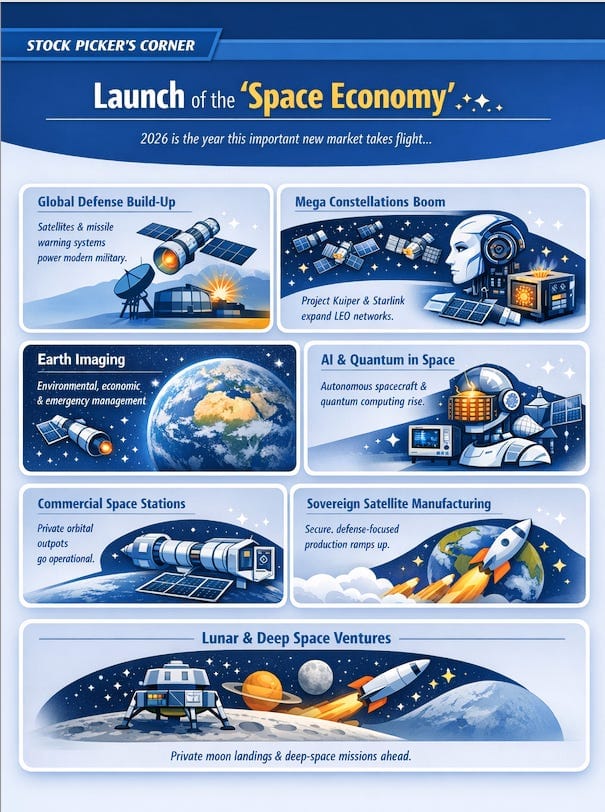
Here at SPC, we’re storyline investors. We believe that if you find the best storylines, you’ll find the best stocks. We not only see the Space Economy as one of the hottest investing storylines of 2026; we see it as one of the top storylines for Wealth Builders for the rest of this decade — a prediction underscored by the disclosure that SpaceX (arguably the favorite company in the Elon Musk “corporate keiretsu”) is on the IPO “launch pad.”
In that Space Economy, we’re talking about a market slice with a $5 trillion upside. Think of it like the economies of Germany ($4.9 trillion) or Japan ($4.3 trillion) orbiting the Earth — with a little left over in either case.
And I’m increasingly viewing these estimates as “light.” A study by McKinsey and the World Economic Forum says the Space Economy was worth $630 billion in 2023 — and could hit $1 trillion by 2030 and $1.8 trillion by 2035.
And if you think about that inflation-adjusted cost estimate of $1.2 trillion for Apollo — and look at what we’re talking about this time around — it’s impossible not to feel revved up by this Wealth Builder opportunity.
And it’s an opportunity we know as well as anyone — and probably better than most.
We were telling you about this two years ago (well ahead of all the “experts” who suddenly “discovered” this opportunity at the start of this year). And we’ve talked about its impact on defense, artificial intelligence — and a whole new satellite game.
Okay, Let’s Make Some Money
So what’s the best way to cash in on the Space Economy?
Exchange-traded funds are decent “base builders” to consider.
And here are three to research.
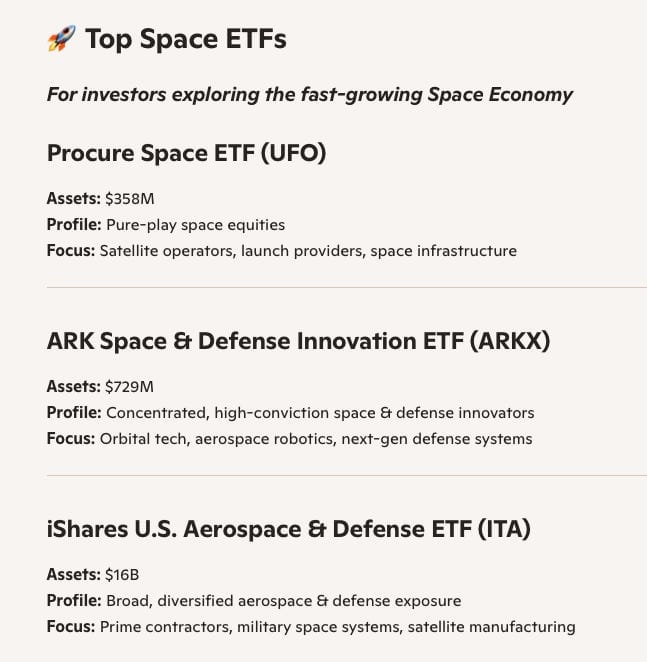
But we’re stock pickers.
That’s where the biggest opportunities fly.
We’ve got two “space stocks” in the SPC Premium Model Portfolio … two (including a real doozy) in our Special-Situation Portfolio … and one more (that we’re really stoked about) on our Farm Team.
Here’s a quick rundown on those five space economy stocks …

Continue Reading
This analysis continues inside Stock Picker’s Corner. Subscribers get access to our full breakdowns of well‑positioned businesses, how we think about risk and opportunity when markets get volatile, and how we approach building positions over time. That includes our reasoning behind each idea, ongoing updates as conditions change, and practical guidance on when to start buying and how to add gradually without trying to time the market. If you’re looking for research that goes beyond headlines and short‑term price moves, you’re in the right place.
Already a paying subscriber? Sign In.