- Stock Picker's Corner
- Posts
- A "Baker's Dozen" List of Venezuela Beneficiary Stock Plays
A "Baker's Dozen" List of Venezuela Beneficiary Stock Plays
Opportunities in oil, tankers, diesel, FinTech, special-situations — and a cool bond play ...

Stock Picker's Corner (SPC)
January 14, 2026
On Monday, I showed you folks how “Operation Absolute Resolve” — the U.S. Delta Force mission to capture Venezuela President Nicolas Maduro — added muscle to most of the top investing storylines we’re following for you here at Stock Picker’s Corner (SPC).
Today we’ll circle back to talk about energy — and the how America’s push into that country could change the energy game here at home.
I got together with Matt Warder, a former Wall Street analyst who now runs The Coal Trader on Substack, got together to talk about energy stocks that could get a boost from America’s amped-up efforts to lock down the Western Hemisphere.
In a wide-ranging talk, Matt identifies near-term beneficiaries of the Venezuelan operation, explains how a new flow of oil could bolster domestic American refineries and pipelines and details how it could slash diesel prices for U.S. motorists. I spotlights top winners from that “Diesel Effect.” And we both highlight the importance of having some of your money invested outside U.S. borders.
Together, we analyzed roughly 15 investments you can look at immediately. They include Big Oil, energy-service firms, tanker operators, American heavyweights, a unique bond play, a “special-situation” turnaround and even a nifty FinTech.
Call it an “Baker’s Dozen.”
Here’s an edited transcript of our talk.
Key Takeaways from Our Energy Deep Dive:
Venezuela’s regime change could reshape global energy flows and U.S. refining capacity.
Guyana oil concessions now unlocked for Exxon (XOM) and Chevron (CVX).
Diesel prices likely to drop, boosting logistics and heavy-duty truck demand.
15 investment ideas spanning Big Oil, oilfield services, tankers, infrastructure, bonds, and even FinTech.
Emerging markets angle: Venezuela bonds and Latin America stocks could surge post-sanctions.
Bill (Q): So, Matt, we’ve had a week or so to process the U.S. operation to capture Venezuelan strongman Nicolas Maduro and his wife … as well as the “what comes next” factor … with respect to the Trump Administration, oil and energy, critical materials, the supply chain and the economy — all of which fall into your bailiwick.
And we’ll use that as a jumping-off spot to talk about longer-term investments … Wealth Builders and Wealth Killers.
Matt (A): Good, good … and let me say – up front — that what Trump Administration says will happen next … and what actually happens … will be two different things.
Okay … let me do a bit of table-setting here … and I’ll leave the politics aside — since I know you want to get to the analysis readers can use …
Regime change in Venezuela is very, very far from a bad idea. The handful of “in-country” people who I know personally have been suffering for over a decade …
And while I’m on the soapbox, regime change in Iran is just fine by me too.
Bill (Q): Interesting you mention Iran. With what we’ve been seeing in Iran — the protests, the brutal crackdowns, the White House tariffs and threats of more — I talked with our good friend Mark Rossano, who’s been predicting this for several years. In fact, when I interviewed him late last year for SPC, he doubled down on his belief that folks in that country — as fed up as they are — would really start pushing for regime change.
When I connected with Mark and reminded him of our talk last year, he kind of chuckled and said: “That’s right, Bill … since 2014 I’ve said the regime would fall by 2030 and that I’ll be doing business there by 2035.”
Matt (A): Mark’s been adamant about that …
Bill (Q): He has, indeed …
But you have been pretty vocal about Venezuela … in fact, after the raid, you published a short version of the analysis you’re sharing here today … and said you heard from lots of folks … pro and con. Correct?
Matt (A): That’s right, Bill, I have, indeed. On all my feeds … my Discord channel … my Twitter feed … via The Coal Trader.
Lots of hand-wringing …
Bill (Q): Hand-wringing … because?
Matt (A): Because people have short memories when it comes to history.
President Barack Obama considered doing this exact same thing — he just ran out of time. And Hillary CERTAINLY would have done it.
My pet conspiracy theory at the time was that Russia became involved in the 2016 election in favor of Trump because Citgo was controlled by PDVSA (the Venezuelan National Oil Company) and Russia owned most of its debt. In the Caribbean, in 2008, Russia even conducted naval operations – almost Bay of Pigs-style – to “signal” the incoming Obama Administration that Moscow was in America’s backyard and wouldn’t be going away.
Maduro’s election in 2013 was a signal to all that the end was here … but nobody did anything about it — they just let Venezuela rot. And whether anyone likes it or not that laissez-faire foreign policy was terrible for America’s economy.
WPIII (Q): What should we watch for … near-term, intermediate-term … long-term?
Matt (A): As I see it, it all depends on how the remaining leadership reacts. My perception of what we did [in Venezuela] was to send a message to the military that actually runs that company that “hey, we can come get you, too.”
Bill (Q): That kind of “messaging” was a key element of the defense/security analysis of the Venezuela operation that we did in SPC earlier this week.
Matt: (A): I saw that …
And you are correct. The messaging has been key here … and we can circle back on that.
For now, down in Venezuela, we avoided the mistake we made in Iraq …
Bill (Q): Where we took out everybody in power … and even those close to the folks in power.
Matt (A): Exactly. That was a mess – for a lot of reasons. There we took out everybody. Here we left the second-in-command in charge.
I expect/suspect that we’ll probably “run” Venezuela similar to how we ran Japan following World War II … not civically administer … but to oversee future elections to ensure they were executed well for the people – that was the goal … and it was made manifestly clear.
[Gen. Douglas] MacArthur oversaw that all. We didn’t run the economy … the Japanese ran it … but we were there as a guidepost. It wasn’t cultural.
In Venezuela, they already imported baseball. It already has an established, Western-style culture. It’s not the same kind of complete reshaping as we did in Japan. The population in Venezuela is distributed along left/right political culture – one that’s closely aligned with ours. It’s really a kind of overarching inborn culture already exists there.
Bill (Q): In terms of economic guidance, we’ll want to ensure fair play?
Matt (A): Yes ... I think so.
[Former Chilean dictator Augusto] Pinochet entrusted his economy to the “Chicago Boys” – the University of Chicago economists, who suggested he run it in a Milton Friedman/Libertarian fashion. As we found, it kind of worked.
If we play the role of the Chicago Boys … with Western companies allowed to come in and rebuild the infrastructure … foreign-direct investment (FDI) will come into the country, and Western companies will benefit and, by and large, will be a large boon to a democratized economy.
People will have jobs again. Jobs will pay market prices. Venezuela will have access to the International Monetary Fund (IMF) — and other things will stabilize the economy … and those are other things that Venezuela and its people haven’t had.
And, as we just talked about, there’s less to mess up here than there was vis a vis Iraq. There it was an issue of “people-making” — creating the management structure that could take over operating the country. That meant Iraq had problems that occupation — military/defense — doesn’t mitigate.
To understand, in Venezuela, the military has to play along. If it doesn’t, there will have to be more U.S. military involvement in the intermediate term.
Bill (Q): Okay, let me circle back … with a couple of “follow-up” questions for some clarity.
When you say his election signaled “the beginning of the end to all,” what do you mean?
And this “hands-off” approach — why was it bad for the economy? What did it do? How would everyday Venezuelan folks have been affected … or hurt … by this?
Matt (A): We didn’t pressure them. Europe didn’t pressure them. Nobody in the G7 pressured them.
And Russia and China were supporting them.
It was, de facto, like having Russia and China operating right here in our hemisphere.
That was totally unacceptable in the ‘60s — with Cuba. And it’s way unacceptable now
Bill (Q): So what is it that President Obama would have done? Talk a bit more about … running out of time.
Matt (A): They were cornered. PDVSA was failing. Russia owned most of the debt. Russia moved in equipment to safeguard its investment. We wrote about this at ECRG — back when you were running Private Briefing and we were all working together at [another financial publisher].
Not only was Russia providing equipment … it was also providing personnel … and also defense mechanisms.
Bill (Q): Let’s talk “Deglobalization” — “Regionalization” — a big storyline for us at Stock Picker’s Corner.
My argument — and one I detailed in our analysis Monday — is that one driver here is “Hemisphere Security.” Your take?
Matt (A): It’s that. And more.
It’s a supply-chain story: The military survives on its regional supply chain. It’s about “shortening” that supply chain.
Bill (Q): Let’s talk energy … specifically, oil.
You made a couple of interesting points here …
Refining … using U.S. capacity.
And the “Diesel Effect.”
Let’s start with refinery stuff … which is fascinating.
Matt (A): Venezuelan crude isn’t just any oil—it’s heavy, and it’s got a higher sulfur content, which basically makes it tailor-made for all of our Gulf Coast refineries. Saudi Arabia, Iran, Russia and Iraq are the only other major suppliers of that quality — without which we struggle to refine enough diesel.
And it’s diesel, by the way, that powers the trucks and railcars that ships to our stores literally everything we buy. In other words, Venezuela has been a necessary piece of the puzzle for keeping the wheels of our economy turning — literally.
And it’s diesel, by the way, that powers the trucks and railcars that ships to our stores literally everything we buy. In other words, Venezuela has been a necessary piece of the puzzle for keeping the wheels of our economy turning -- literally.
Bill (Q): I want to come back to this when we talk about investments.
For now, let’s talk about how this plays out.
Matt (A): To start with, some of the initial impact won’t be in Venezuela … because the infrastructure is going to take years to rebuild. It’s going to be Guyana that makes the initial difference.
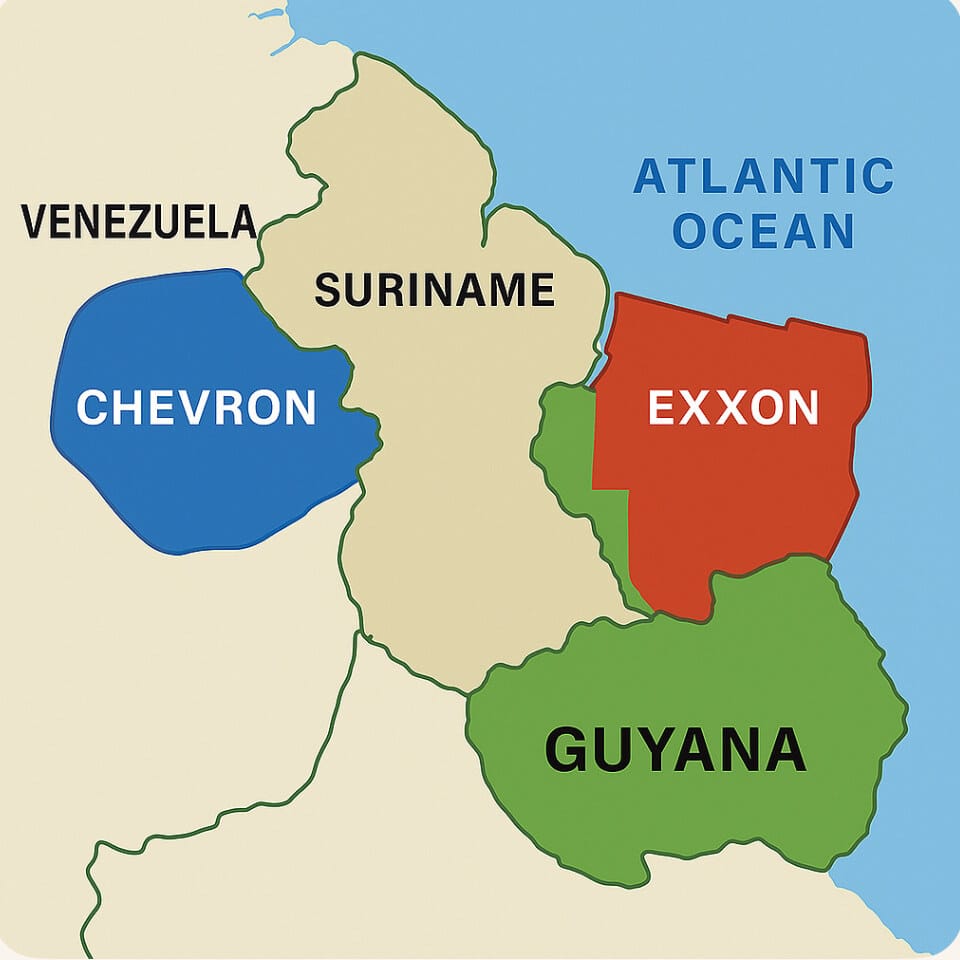
For years, Maduro contested the claims of Exxon and Chevron with respect to the concessions they had in Guyana. As a result, neither company was able to develop them during that period of time.
The removal of Maduro immediately makes those concessions developable. And the quality of production is not going to be terribly dissimilar. It should be heavy enough to function in a similar fashion accessible to the refinery crude we want here in the states.
What I think will wind up happening … is that there will be more heavier crude available … more diesel for our refineries to produce … which will lower logistics costs in the U.S. And that will go a long way in keeping down economic-goods inflation.
And fuel is the big cost for trains and trucks.
Maybe over a five-year time horizon.
Bill (Q): So if we look at this as a whole — and look past any near-term euphoric reactions — where are the long-term opportunities:
Refineries?
Big Oil?
Pipelines?
Railroads?
Logistic plays?
Auto-related?
Defense-security?
Matt (A): The obvious longs are Exxon Mobil XOM 0.00%↑ and Chevron CVX 0.00%↑Both have refinery arms and access to Guyana. Chevron already has permission to operate in Venezuela.
But as we saw from the debate after the attack … there will be wrangling.
They’re going to need some kind of hall pass from the government.
Step 2 will the oilfield-service providers:
Schlumberger SLB 0.00%↑ .
Halliburton HAL 0.00%↑.
Or “insert-company name” here.
The bigger companies will benefit sooner. But it’s too early to see it all.
Bill (Q): What else?
Matt (A): Probably buy the VanEck Oil Services ETF OIH 0.00%↑. This puts it on the table as a “Buy” for the longer term.
Year to date, OIH is up 10%. … but over year … only 13%. So the biggest gain over the past year … which was in the single week after the Venezuela mission.
If you look at the five-year chart … the high in 2024 was $336 … it corrected down to $210. Come Liberation Week … it’s crept up to test highs — $350 — with all the news.
With all the added potential volume, it’s fit to break all-time highs relative soon … it’s an idea of how robust the cycle is … look out to the middle or later part of the year — so Q2 or Q3.
Oil tankers … if we see that production increase from Venezuela … Guyana … we’ll have to ship more … oil tankers will emerge as a winner.
One to look at: DHT Holdings Inc. DHT 0.00%↑ — operator of oil tanker fleets … very-large crude carriers.
Another one is Frontline PLC FRO 0.00%↑ , which operates very large crude carriers (VLCCs), Suezmax tankers and LR2/Aframax tankers.
There’s also Teekay Corp. Ltd. TK 0.00%↑ — which operates a mix of crude and production tankers.
Maybe Euronav NV [which is listed overseas]. Year-to-date, it’s up 16%.
I think your strategy of “Accumulating” … and dollar-cost-averaging … is the way to go. Definitely not YOLO [you only live once] is not the path right now.
This might be a slow burn. For most of these ideas.
Finally, maybe look at Tenaris SA TS 0.00%↑, which makes steel pipe and other products for pipelines.
Bill (Q): A good infrastructure play to look at … when the construction comes along?
What else?
Matt (A): Venezuela Government Bonds … 9¼ 2027 bonds, for instance … are an obvious one now … since they’ve gone from “Holy S#$T, they’re gonna fail” to “Hey, they might make it.” From “catastrophic” to “less bad.”
They’ve experienced the biggest rate of change in underlying prices.
Last of all … buy the Caracas stock market … once the sanctions go off … buy a Venezuela index fund. There may soon be better ways to play the Venezuela market.
This plays into the emerging-markets theme for the rest of the decade thanks to dollar weakness.
Bill (Q): Staying in our hemisphere, but getting outside the United States, we recently added a promising Latin America stock to our Model Portfolio. We like Latin America’s Nu Holdings Ltd. NU 0.00%↑, which is on our formal “watch list.” Since these other companies are all energy-related, here’s a financial-services/FinTech stock that gets folks into Latin America.
Let’s circle back to your “Diesel Effect” thesis, which I really like.
Matt (A): It will have a big impact, economically. It’ll lower diesel costs for America.
Bill (Q): You’re 100% right about the diesel truck market — and the benefits you’re talking about. Take a look at this chart I found.

The global diesel truck market was worth $308 billion in 2024 – and will hit $498 billion by 2033, says Business Research Insights. So … you’re talking about a CAGR of 5.7% — or double the growth rate of the overall economy.
There’s another facet of this that I know about as a lifelong motorhead/hot-rodder … one that’s big for consumers.
Most folks don’t realize this … but diesel pickups have become the “Station Wagon of the 2020s” here in America …
Station wagons were the family vehicle of choice in the 60s and 70s — my folks had three in a row: An Oldsmobile in the early ‘60s, a Ford Country Squire in the late ‘60s and a Chevy Impala in the middle 1970s.
When the 1980s came along, the late, great Lee Iacocca invented something new — called a minivan. Those sold like hotcakes — and helped remake Chrysler as a winner.
In the ‘90s, SUVs became the mainstay.
In the early 2000s, pickups became the family caravan. And the “hot ticket” is the diesel pickup.
Grand View Research says the global pickup market will grow from about $226 billion in 2024 to $269.5 billion by 2030 — a CAGR of 3.2%. But here’s where your thesis gets interesting.
North America accounts for 77.5% of global pickup market revenue — about $177 billion in 2024 — so America is the axis of the pickup universe.
Here’s where we bring it back to diesel.
The mid-tier slice of the market is no longer diesel focused. But heavy-duty (HD) trucks account for as much as 30% of all pickup sales. And 70% to 90% of heavy-duty trucks sold use diesel engines.
So we’re talking about a U.S. market of $30 billion to $50 billion — just in pickups. That market is growing faster than the overall economy. And while diesel pickups are expensive, a long-term drop in diesel prices will spur demand for diesel-powered pickups.
I have good friends who own and drive heavy-duty diesel trucks as everyday vehicles. Drop fuel costs … and that’ll keep happening.
And demand for trucks will spur demand for diesel powerplants.
And not just in pickups … in heavy trucks, heavy equipment, railway upgrades … so that’s all good.
I see several opportunities here.
The first is Cummins Inc. CMI 0.00%↑, a company whose diesel engines are legendary.
Interestingly, Morgan Stanley analysts just put Cummins on its list of seven companies best-positioned for an upside earnings surprise. (One other company on the list: Halliburton.)
Another play — probably one you’d have to Accumulate here, for sure — is Caterpillar Inc. CAT 0.00%↑ , a company I covered back during my business reporter days in York, Pa. Cat’s yellow-and-black earthmoving equipment is iconic. And so are its diesel engines. The stock is expensive here. But Deglobalization, the “reindustrialization” of America, the boom in both AI data centers and semiconductor fabs and (now) the reconstruction of Venezuela are “Triggers.”
At CES 2026, Cat CEO Joe Creed talked about a partnership with Nvidia Inc. NVDA 0.00%↑ that revs up the use of AI in robotic vehicles. It also showcased a branded AI assistant that allows voice-directed operation of its heavy equipment. Lower diesel fuel costs change the equation here in the U.S. market.
Matt (A): If this plays out as I believe, you’ll see diesel prices drop closer to pump gasoline.
Bill (Q): One last company to look at — one that fits well in my Contrarian Investing wheelhouse — is Stellantis NV STLA 0.00%↑ . The company has struggled — the stock is down 20% over the past year and nearly 45% over the past five — but is making moves even as we speak. Stellantis owns both the Jeep and Chrysler brands. And Chrysler operates Dodge, which makes the Ram pickup. The Ram is a fine truck — I have one myself, though it’s Hemi-powered. But my best friend Harry and my nephew Josh each drive Dodge Ram diesels. A drop in diesel prices could nudge up demand for trucks, which are high-margin vehicles. That, coupled with the ongoing corporate turnaround — it’s getting rave reviews for its Detroit Auto Show game plan — could ignite the stock, which trades for around $10.
Matt (A): Interesting … there’s also defense/security, which we teased at the start. Messaging is getting important. And if you spin the rhetoric, your enemies need to understand you can back it up. It’s worth watching.
Bill (Q): That’s more than a dozen investments — kind of a souped-up “Baker’s Dozen,” or an “SPC Special.”
Thanks, Matt.
Check out his work at The Coal Trader, and check out below for the recap on all the investable opportunities we talked about today.

Recap of the Stocks/Investments Mentioned
Here’s the full list grouped by category:
Big Oil & Refining
Exxon Mobil (XOM) – Guyana concessions, refinery capacity.
Chevron (CVX) – Already cleared for Venezuela operations.
Oilfield Services
Schlumberger (SLB)
Halliburton (HAL)
VanEck Oil Services ETF (OIH) – Diversified oil services exposure.
Tankers & Shipping
DHT Holdings (DHT) – VLCC operator.
Frontline PLC (FRO) – VLCC, Suezmax, LR2/Aframax tankers.
Teekay Corp. (TK) – Mixed crude and production tankers.
Euronav NV – Overseas-listed tanker play.
Infrastructure & Pipelines
Tenaris SA (TS) – Steel pipes for pipelines.
Special Situations
Venezuela Government Bonds (9¼ 2027) – From “catastrophic” to “less bad.”
Caracas Stock Market / Venezuela Index Fund – Post-sanctions emerging-market play.
FinTech / Latin America
Nu Holdings Ltd. (NU) – Latin America financial services.
Diesel Effect Plays
Cummins Inc. (CMI) – Diesel engines, upside earnings potential.
Caterpillar Inc. (CAT) – Heavy equipment, AI integration, diesel engines.
Stellantis NV (STLA) – Jeep/Ram pickups, turnaround story.
Want More Actionable Ideas Like These?
This deep dive is just the start. At Stock Picker’s Corner, we track the biggest geopolitical and economic shifts — and translate them into real investing opportunities before Wall Street catches on.
Join SPC Premium today and get full access to our research, alerts, and community.